
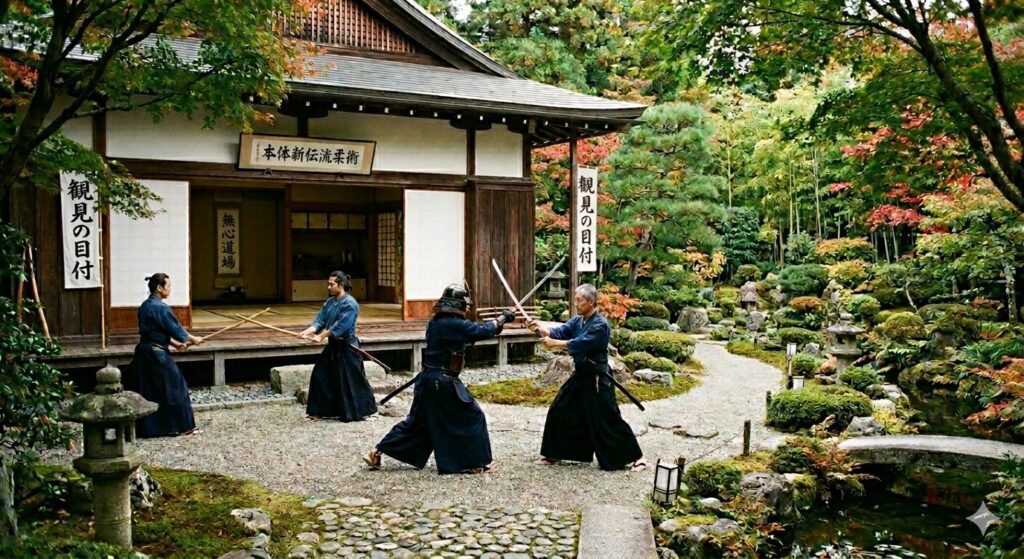
So you’re interested in training in martial arts for the first time. Now what? The first thing you should do is panic and run around in a complete frenzy. Once you get that out of your system, it’s time to put on your game face and make a plan.
Which art is which?
There are many reasons why people continue to train in martial arts, but in the beginning developing some skills to defend oneself is usually at the top. How do you determine which art is best for you? It depends upon your ultimate goals. Martial arts were not all created equal, and they all have a particular focus. For example if one is a fan of MMA and wants to participate in those types of competitions, then naturally a dojo that teaches Brazilian Jūdõ or MMA would be better than a dōjō that teaches anything else.
Popular arts in brief:
Brazilian Jūdō (juijitsu): sport Jūdō & wrestling
Karatedō: solo forms emphasizing linear motion and strong strikes, self-defense, sparring
Kenpo: much like karate but more emphasis on circular motion and fast combinations
Taekwondō: solo forms, high kicks, self-defense, lots of sparring
Muay Thai: sport kick boxing
Krav Maga: striking, basic grappling & self-defense against weapons based on Israeli military and police training, which adopted aspect of other martial arts.
Kung-fu: Chinese martial arts that differ widely, but generally emphasize elaborate solo forms practiced against imaginary opponents.
Aikidō: soft passive self-defense that’s designed to not hurt anyone.
Tai Chi: slow forms for health benefits practiced mostly by old people in China.
Bujutsu: Samurai era martial arts designed for use in the battlefield. Modern practitioners emphasize the combat effectiveness in all situations including weapons scenarios.
This might require some research such as reading websites like this one. Don’t forget about books! Libraries can be a great resource, or order some books on Amazon. Reading martial arts books while sipping a latte at a café is tres chic. Not really – don’t do that! But before you spend years training in an art that you later realize wasn’t what you wanted, spend some time researching martial arts and hopefully this will help you narrow down your desire to train in something specific.
Determine the best fit for you.
All of that information might not help if what is available in your area is limited. Most people actually fall into this category to some degree or another. Those who are really serious will travel a little further to get the training that is best for them, while most others will settle for what is close by and fits into their schedule or budget. It might not be ideal, but in the end some training is probably better than no training. Make the best of it and get as good as you can and you may be surprised at how rewarding it is.
Another important aspect is finding a group that is friendly and shares a passion for their chosen martial art. Be sure it is an instructor and group of people you will feel comfortable around for a period of years. If there are big egos, bad attitudes, or more interest in signing you to a costly contract, walk away. Always look behind you as you leave such a school in case they throw shuriken at you.
A quality instructor is important, but this can be nearly impossible to decipher in the beginning. A certificate on the wall likely isn’t worth much. The instructor may have legitimate rank, but many have bogus ranks that are about as hard to get as a certificate from the Universal Life Church. A piece of paper doesn’t mean much when being attacked by a criminal and it won’t guarantee quality instruction either. An instructor should be willing to discuss any certificates on display so don’t be afraid to ask them about it.
Beyond that, and more importantly, look for friendly and helpful demeanor, confidence but not an intimidating bully, and someone who is willing to answer questions with in-depth insight. Another key point is watching how an instructor teaches other students. Is he obviously bored and doesn’t care if students can do what is being taught? I’ve seen that on more than one occasion. Or does he take extra effort to help those that aren’t quite getting it?
Most schools offer some free classes, so go for it and try it out. A little hands-on experience will inform you in ways that books cannot. Don’t be pressured into signing a contract! Martial arts schools in big cities like to use contracts to milk students of money and don’t care if they ever actually train. That is the negative side of martial arts, when unscrupulous people try to use martial arts just to make money. Be warned.
Also some schools will attempt to teach a mishmash of various martial arts. If a school offers Karate, Kenpo, Kung-fu, Pencak Silat, Aikidō, and Capoeira, and it is one guy teaching all of it, you can assume that the instructor didn’t master any of those. Occasionally you might find a school where each art is taught by a different instructor, which is much better, but don’t be fooled by the allure of learning “all” martial arts. That’s like learning to speak all foreign languages at once. Find the right art and master it.
Set a realistic goal
A couple of free classes won’t be enough to know more than just the general vibe of the school and the feel of the instructor(s). Those who achieve notable skills in martial arts know that it is an endeavor measured in years of hard work that becomes a life-long pursuit. However once you commit to train at a school you should give your chosen art a six month or year long trial to get a decent understanding of what that art will entail. Let that be your first goal and re-evaluate if you find that you are less than confident that you are on the right path.
Most martial arts instructors will tell you that most students don’t make it beyond 6-12 months. Some of this is much like the reasons people join a gym and quit within a couple of months. Yeah, it’s hard work and it will take a lot of time. If it were easy, everyone would be a martial arts master. There are a lot of demands that people have on their time, including spending way too much time in the digital realm and not enough time moving your body. But it also can be that students re-evaluate the school and decide to switch to something better, like upgrading to training in Bujutsu.
Follow through
This is the hard part and is what will determine success or failure. If you don’t follow through and spend a handful of years training, you will quite possibly regret it and always wish in the back of your mind that you stuck with it and reached the goal of being a talented martial artist. Or at least make it to black belt. The consolation prize is that some training is better than none and the 6-12 months that most people train will likely give them just enough skill to handle most situations they find themselves in. And if you are pretty careful about what you do in life you will probably be able to avoid violent confrontations anyway.
For those intrepid travelers in the martial path that can get beyond the steep learning curve and get through a few years of training, keep going! You will be well on your way to achieving something that will be among the most rewarding things you can accomplish in your life, which will empower you to achieve the most out of life. And you may just develop the skills necessary to survive the Zombie Apocalypse. Which is a real thing.

Leave a Reply