

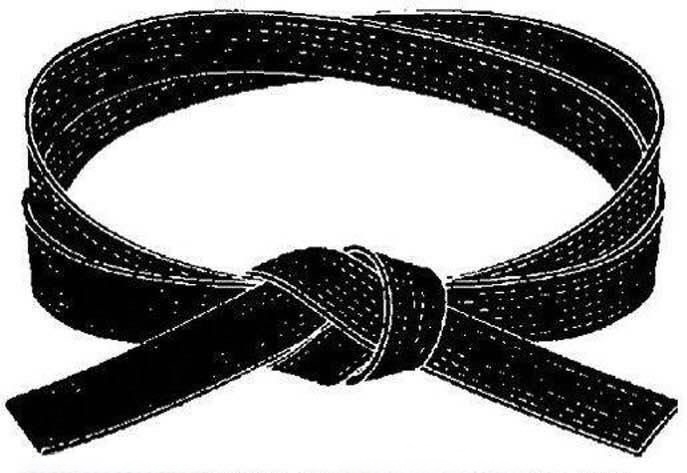
This is a common question. The modern Budō martial arts made the attainment of a black belt famous during the 20th C, but largely the importance of this is blown out of proportion around the world. Many think that a promotion to black belt represents mastery, but more accurately in Japan and Okinawa the rank of black belt is more akin to the real start of training. The color belt levels are usually seen as the phase of learning fundamentals needed to have a foundation to understand the more advanced material that is the “real training” which begins at black belt level.
In one way, while a white belt marks the introductory level, a black belt in Japan is more often seen as the real beginning of training. As an analogy, the color belts are like grade school and the black belt levels are like college. Attaining the rank of black belt is a good goal to have, and for many people it will be as far as they will go. Black belt skill level in martial arts should provide most people with the basic skills they need to defend themselves. However all arts are not created equal and standardization is difficult to find in any martial art.
The material covered can be standardized fairly easily, but the skill level is very subjective, so it’s not hard to find a range of skill levels at the same rank, not only among different styles of the same art, but also in different dōjō teaching the exact same art. Even within a given dōjō there can be noticeable differences in skill levels among students with the same rank. So what does that mean?
For one people are all different. Some are more fit or physically coordinated, some are more academically gifted, some people just coast along with whatever is good enough and some have more drive to get as good as possible and put in more time outside the dōjō with supplemental solo training. Some people spend more time pondering the techniques and the principles behind them even when they are not training. Others may learn the material well enough to demonstrate some knowledge, but don’t push themselves to excel in the physical skills. This can be cumulative, becoming more distinct with each promotion.
It is not unlike grade school where students may be in the same grade but some students excel beyond the average of the class and some lag behind. The same class performance may be flipped when it comes to abilities in sports. Students with the same coaches and same amount of time practicing don’t all exhibit the same skill levels and there will almost always be a few stand out players and even a “star” of the team. In the end, there can be no absolute objective standardization of the subjective qualities expected in a skill. The academic grade levels don’t achieve this, nor do sports teams. Why do we expect this in martial arts, which combines both academic knowledge of techniques and physical skills in their application? We can’t be blinded by idealistic expectations that are thrust on us by entertainment media, which all too often presents a black belt as a master.
A ranking system is just a guide. The reality is that everyone will have slightly different real world abilities despite their rank. Color belt students can be quite skillful enough to handle attacks by criminals. In fact criminals won’t care what belt ranking a person has. Some weak-minded criminals might be deterred from assaulting you just by confidently stating that you have a black belt, but that sort of ruse can’t be relied upon. Also it is extremely important to keep in mind that samurai did not present certificates before a battle to attest to their skill level. Any sort of ranking in martial arts was just a way to measure progress in a particular style, and it never got in the way of combat. Today it is no different. The rank matters less than the skill, and I have had students successfully defend themselves from knife-wielding attackers with only three months of training.
What does it all mean? For starters there is no answer for how long does it take to get to black belt. There are many variables such as how consistent a students makes it to training and how much one works on developing the skills. Each person will vary in their efforts and abilities, so the reality is that the rank will mean different things for different people. The quality of a rank will be a personal matter and not one with an easy answer. The worst feeling would be to get an overly easy black belt in very little time through some McDojo that feels hollow after receiving it.
There should not be a rush to get a specific belt, so we shouldn’t feel pressure to get there. We should focus on quality of each rank instead of attaining more rank. The Kochō Dōjō tries to fall somewhere in the middle on the importance of rank. It is pointless to hand them out quickly and easily, yet we can’t take a belt color too seriously either because they don’t matter in combat, which is one of the main purposes for training. If we don’t rush through the ranking system and try to put as much effort that we can into every rank, then every promotion will be a meaningful accomplishment. No matter how long it takes to reach black belt, it will actually mean something when we get there.
Leave a Reply